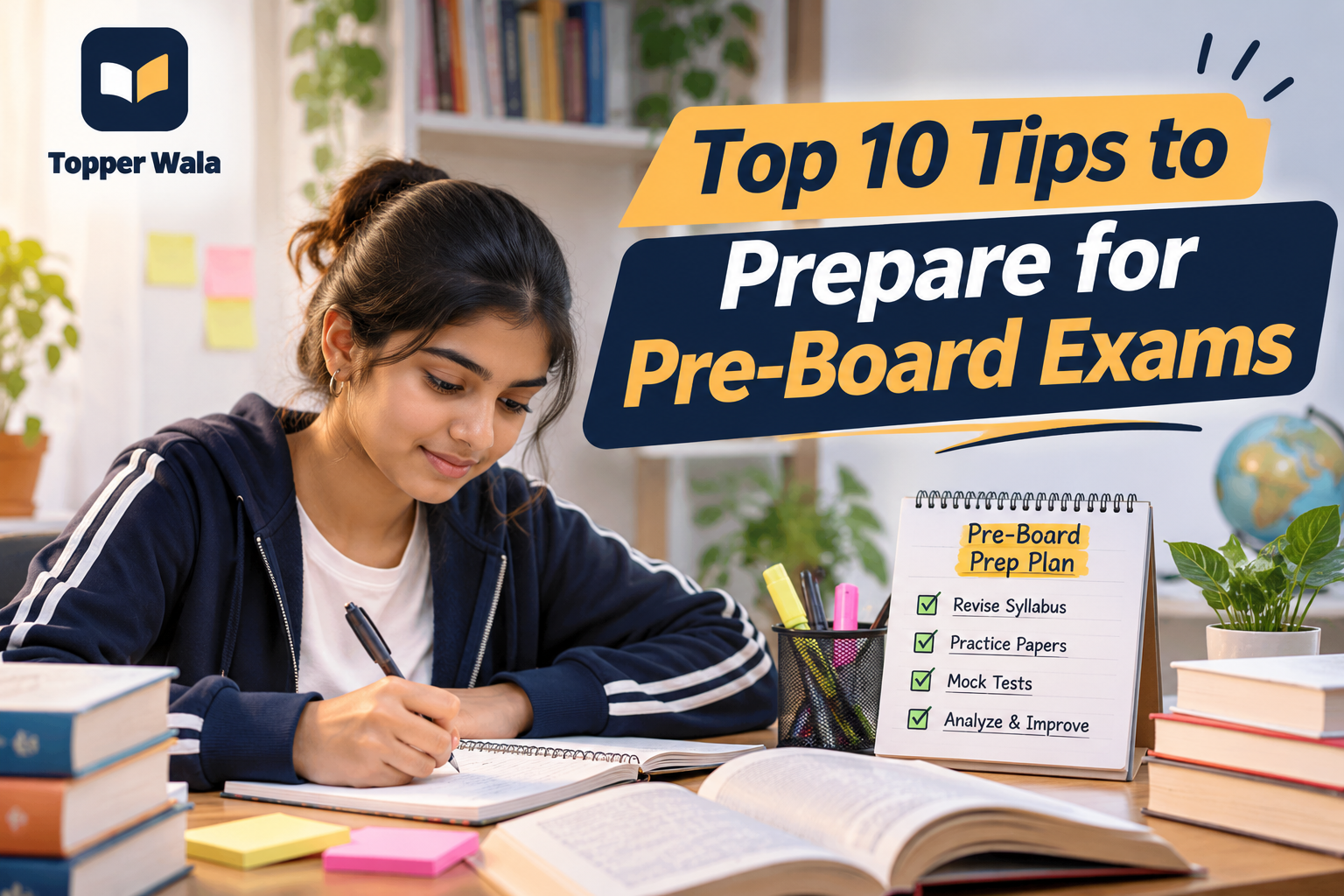
Top 10 Tips to Prepare for Pre-Board Exams
Pre-board examinations play an important role in helping students prepare for their final board examinations. They allow students to assess their academic performance, identify weak areas, improve answer-writing skills and develop confidence before the actual examinations.
However, completing the syllabus alone does not guarantee good marks. Students need a structured preparation strategy that combines regular revision, effective time management, conceptual clarity and sufficient practice.
Whether you are preparing for Class 10 or Class 12 examinations, following the right study habits can improve your performance. Here are ten practical preparation tips from topperwala to help you approach your examinations with greater confidence.
1. Create a Realistic Study Timetable
A well-planned study timetable helps students organise their preparation without feeling overwhelmed. Instead of studying randomly, divide your available time according to the syllabus, subject difficulty and individual preparation level.
Give additional attention to subjects that require more practice while maintaining regular revision of your stronger subjects.
How to Create an Effective Study Timetable?
-
Set daily targets: Divide larger chapters into smaller, manageable sections.
-
Prioritise difficult subjects: Allocate additional study time to challenging topics.
-
Include revision sessions: Reserve time every day to revise previously studied concepts.
-
Schedule regular breaks: Take short breaks between study sessions to maintain concentration.
-
Track daily progress: Review completed tasks before planning the following day.
-
Maintain flexibility: Adjust your timetable whenever a topic requires additional preparation.
Avoid creating an unrealistic schedule that requires continuous studying for several hours. A balanced timetable encourages consistency and reduces unnecessary academic pressure.
2. Complete the Syllabus Before Starting Intensive Revision
Incomplete syllabus preparation often creates anxiety as examination dates approach. Students should aim to finish their prescribed syllabus sufficiently early to allow time for revision and practice.
Start by reviewing the syllabus provided by your school or education board. Prepare a checklist of chapters and identify topics that remain incomplete.
How to Complete Your Syllabus Efficiently?
-
Begin with chapters that require greater conceptual clarity.
-
Divide lengthy chapters into smaller study sessions.
-
Complete pending textbook exercises.
-
Clarify doubts with teachers whenever necessary.
-
Maintain a checklist of completed and pending topics.
-
Avoid leaving difficult chapters until the final week.
Students preparing for CBSE examinations should pay particular attention to prescribed NCERT textbooks and applicable syllabus requirements.
Completing the syllabus early provides sufficient opportunities to practise questions, strengthen weak areas and improve examination readiness.
3. Focus on Conceptual Clarity Instead of Memorisation
Memorising information without developing conceptual clarity may help students answer straightforward questions, but it can create difficulties when examinations include application-based or competency-based questions.
Students should focus on the principles behind each concept rather than simply remembering definitions and answers.
Effective Ways to Strengthen Conceptual Clarity
Explain difficult concepts in your own words after completing a chapter. This technique helps identify gaps in your preparation.
Use diagrams, flowcharts, practical examples and illustrations wherever appropriate. Visual learning methods can make complex information easier to remember.
For Mathematics and Science, focus on the reasoning behind formulas, calculations and scientific processes. For Social Science, examine relationships between historical events, geographical factors and economic developments.
Similarly, students preparing for language examinations should focus on grammar, comprehension and clear written expression.
Strong conceptual preparation makes it easier to answer unfamiliar questions and apply academic knowledge accurately.
4. Solve Previous Years’ Question Papers and Sample Papers
Practising question papers remains one of the most effective ways to prepare for school examinations. It helps students become familiar with question formats, marking schemes and the types of answers examiners expect.
Previous years’ papers also help students identify recurring concepts and assess their preparation.
Benefits of Solving Sample Question Papers
-
Improves examination time management.
-
Develops familiarity with different question formats.
-
Highlights areas that require additional revision.
-
Strengthens problem-solving abilities.
-
Improves answer-writing speed and accuracy.
-
Builds confidence before examinations.
Attempt question papers within the prescribed examination duration. Avoid checking textbooks or notes while solving them.
After completing each paper, evaluate your answers carefully. Identify whether mistakes resulted from incomplete preparation, calculation errors, misinterpretation or poor time management.
Use sample papers that align with your current syllabus and examination pattern. Older question papers may contain topics that no longer form part of the prescribed curriculum.
5. Prepare Short Notes for Quick Revision
Reading entire textbooks repeatedly can consume considerable time, particularly when examinations approach. Short revision notes allow students to revisit essential information efficiently.
Effective notes should contain relevant facts, formulas, definitions, concepts and important examples.
What Should Your Revision Notes Include?
| Subject | Recommended Revision Material |
|---|---|
| Mathematics | Formulas, theorems and calculation methods |
| Physics | Laws, formulas, derivations and numerical concepts |
| Chemistry | Chemical reactions, equations and definitions |
| Biology | Labelled diagrams, terminology and biological processes |
| Social Science | Important dates, events, maps and key concepts |
| English | Grammar rules, literary themes and writing formats |
| Accountancy | Accounting formats, formulas and adjustment entries |
| Economics | Definitions, graphs, formulas and economic principles |
Use headings, keywords and brief explanations to organise your notes. Avoid copying entire textbook paragraphs.
Students can also prepare flashcards for important definitions, vocabulary and formulas. Regularly reviewing these materials helps strengthen information retention.
6. Practise Effective Time Management
Knowing the correct answers does not always translate into high marks. Students must also complete their examination papers within the allocated time.
Poor time management may result in incomplete answers, rushed calculations or unanswered questions.
How to Improve Examination Time Management?
Start by solving practice papers under timed conditions. Allocate time according to the marks and complexity of each question.
Read the question paper carefully during the permitted reading time, if applicable. Identify questions that you can answer confidently and follow the examination instructions regarding question order and choices.
Avoid spending excessive time on a single difficult question. Move forward when necessary and return to unfinished questions later, where the examination format permits.
Reserve a few minutes at the end to review your answers, check calculations and confirm question numbering.
Regular timed practice helps students develop a suitable answering pace without compromising accuracy.
7. Identify Weak Areas and Work on Them Regularly
Every student has subjects or topics that require additional attention. Ignoring these areas can negatively affect overall examination performance.
Review previous class tests, assignments and practice papers to identify recurring mistakes.
How to Improve Your Weak Subjects?
-
Identify the problem: Determine whether the difficulty involves conceptual clarity, memorisation or practical application.
-
Revisit basic concepts: Strengthen foundational knowledge before attempting advanced questions.
-
Seek academic support: Ask teachers to clarify difficult topics.
-
Practise regularly: Solve additional questions related to weaker chapters.
-
Maintain an error notebook: Record recurring mistakes and their corrections.
-
Monitor improvement: Conduct short self-assessments at regular intervals.
Avoid dedicating all your preparation time to subjects you already find easy. A balanced approach helps improve overall academic performance.
Even small improvements in weaker subjects can make a meaningful difference to your total marks.
8. Improve Answer-Writing and Presentation Skills
Clear and organised answers help communicate academic knowledge effectively. Students sometimes lose marks because they provide incomplete explanations, omit important steps or present answers poorly.
Good answer-writing skills become particularly important in descriptive and numerical examinations.
Tips to Improve Answer Presentation
Read each question carefully and identify what it asks. Pay attention to instructional terms such as define, explain, compare, calculate and differentiate.
Write answers according to the marks allocated to each question. Short-answer questions generally require concise responses, while longer questions may require detailed explanations.
Use relevant headings, subheadings and points wherever appropriate. Draw neat, labelled diagrams when questions require visual explanations.
For numerical questions, include formulas, calculation steps and appropriate units. Avoid writing only the final answer when the marking scheme awards marks for intermediate steps.
Maintain readable handwriting, correct question numbering and consistent spacing throughout the answer sheet.
Practising written answers regularly helps students improve both speed and presentation.
9. Maintain a Healthy Routine During Examination Preparation
Academic performance depends on physical health and mental well-being as much as study preparation. Studying continuously without adequate rest can reduce concentration and increase fatigue.
Students should maintain a balanced routine that supports both academic productivity and personal health.
Healthy Habits to Follow Before Examinations
-
Maintain a consistent sleeping schedule.
-
Eat nutritious meals at regular intervals.
-
Drink sufficient water throughout the day.
-
Take short breaks during extended study sessions.
-
Participate in light physical activities.
-
Limit unnecessary mobile phone and social media usage.
-
Avoid excessive caffeine consumption.
-
Practise simple relaxation techniques when feeling stressed.
Teenagers generally need eight to ten hours of sleep each night. Adequate sleep supports memory, concentration and emotional regulation.
Avoid staying awake throughout the night before an examination. A well-rested student can concentrate more effectively and approach questions with greater clarity.
Parents should also encourage healthy study habits without creating unnecessary pressure through comparisons or unrealistic expectations.
10. Revise Regularly and Conduct Self-Assessments
Revision strengthens memory and helps students retain information for longer periods. Instead of completing each chapter once and moving forward, revisit previously studied concepts regularly.
Self-assessment also allows students to measure their academic progress and identify areas that require further preparation.
Effective Revision Techniques for Students
Active recall: Close your textbook and attempt to recall important concepts, definitions and formulas without referring to your notes.
Spaced revision: Review topics at increasing intervals to improve long-term information retention.
Written practice: Write answers, solve numerical problems and practise diagrams regularly.
Self-testing: Attempt short quizzes and chapter-based assessments to evaluate your knowledge.
Error analysis: Review incorrect answers and identify the reasons behind each mistake.
Quick revision: Use flashcards, summaries and formula sheets during shorter study sessions.
Regular revision can reduce last-minute preparation pressure. It also helps students enter the examination hall with greater confidence in their academic abilities.
How to Prepare for Pre-Board Exams in 30 Days?
A structured 30-day preparation schedule can help students organise their remaining study time effectively.
| Preparation Period | Recommended Study Activities |
|---|---|
| Days 1–7 | Complete pending chapters and strengthen basic concepts |
| Days 8–14 | Revise major subjects and practise textbook questions |
| Days 15–21 | Solve sample papers and improve weak areas |
| Days 22–26 | Attempt timed mock examinations and analyse mistakes |
| Days 27–30 | Review important concepts, formulas and revision notes |
Students should adjust this schedule according to their syllabus completion, examination dates and individual academic requirements.
Avoid introducing too many unfamiliar study materials during the final preparation phase. Focus primarily on prescribed textbooks, prepared notes and relevant practice papers.
Common Mistakes Students Should Avoid During Pre-Board Preparation
Even students who dedicate considerable time to studying may struggle because of ineffective preparation habits.
Some common mistakes include:
-
Starting preparation too close to the examination dates.
-
Depending entirely on memorised answers.
-
Ignoring difficult subjects and chapters.
-
Studying without a structured timetable.
-
Avoiding written practice and mock examinations.
-
Using too many reference books simultaneously.
-
Sacrificing sleep to complete the syllabus.
-
Failing to review mistakes after practice tests.
-
Comparing preparation progress with classmates.
-
Neglecting regular revision.
Identifying and correcting these habits early can improve preparation efficiency and reduce examination-related stress.
Why Are Pre-Board Examinations Important for Students?
Pre-board examinations provide students with an opportunity to experience examination conditions before their final board assessments.
They help teachers evaluate academic progress and identify learning gaps. Students can use their results to improve subject knowledge, answer presentation and time management.
These examinations also encourage students to develop greater academic discipline and become familiar with longer examination papers.
However, pre-board marks should primarily serve as feedback rather than a final judgement of academic ability. Students who receive lower marks can still improve their performance through targeted preparation, consistent revision and appropriate academic support.
How Can Parents Support Students During Pre-Board Preparation?
Parents can contribute positively to examination preparation by providing a supportive home environment. Encourage students to follow a realistic timetable, maintain healthy routines and communicate their academic difficulties.
Provide a quiet study space and minimise unnecessary distractions. Avoid comparing marks with other students or placing excessive pressure on academic results.
Parents should appreciate consistent effort, improvement and responsible study habits. Supportive communication can help students manage examination anxiety and maintain motivation throughout the preparation period.
Conclusion
Preparing for examinations requires consistency, effective planning and a balanced approach to studying. Completing the syllabus, practising sample papers, improving answer-writing skills and revising regularly can strengthen academic performance.
Students should treat their pre-board results as an opportunity to identify areas for improvement before the final board examinations.
At topperwala, we encourage students to develop effective study habits, make informed academic decisions and approach examinations with confidence. A realistic preparation strategy and consistent effort can help students achieve their academic goals without unnecessary stress.
FAQs
1. What are pre-board exams?
Pre-board exams are school-level preparatory examinations conducted before final board examinations. They help students evaluate their academic preparation, identify weak areas and become familiar with examination patterns and time limits.
2. How should I start preparing for pre-board exams?
Start by reviewing your syllabus, creating a realistic study timetable and identifying difficult chapters. Complete pending topics, revise regularly and solve sample question papers under timed conditions.
3. How many days are enough to prepare for pre-board exams?
Approximately 30 to 45 days can provide a useful preparation period for students who have already covered most of their syllabus. The required preparation time depends on individual academic progress and subject difficulty.
4. How many hours should students study for pre-board exams?
Students may allocate four to six hours of focused self-study outside school when their schedules permit. However, study quality, consistency, adequate sleep and individual learning requirements matter more than the number of hours.
5. Are pre-board exams more difficult than board exams?
Some schools set challenging pre-board question papers to assess students’ preparation thoroughly. However, the difficulty level varies between schools, subjects and examination papers.
6. Are NCERT books sufficient for CBSE pre-board exams?
Prescribed NCERT textbooks provide an important foundation for CBSE examination preparation. Students should also practise relevant sample papers, textbook exercises and application-based questions according to their syllabus.
7. Can I score 90% in pre-board exams with one month of preparation?
Scoring 90% may be possible with one month of focused preparation, depending on your existing knowledge, syllabus completion and study habits. Consistent revision and written practice can improve performance, but no preparation method guarantees a particular score.
8. How can I reduce stress before pre-board exams?
Follow a realistic study schedule, maintain adequate sleep, take regular breaks and avoid last-minute syllabus preparation. Discuss academic difficulties with teachers, parents or school counsellors when necessary.
9. Do pre-board exam marks count towards final CBSE board results?
Pre-board theory examination marks generally do not directly contribute to final CBSE board theory marks. Prescribed internal assessments and practical examinations follow separate evaluation requirements.
10. What should I revise one day before pre-board exams?
Review important formulas, definitions, diagrams, chapter summaries and previously corrected mistakes. Avoid starting lengthy unfamiliar chapters, organise your examination materials and get sufficient sleep before the examination.
