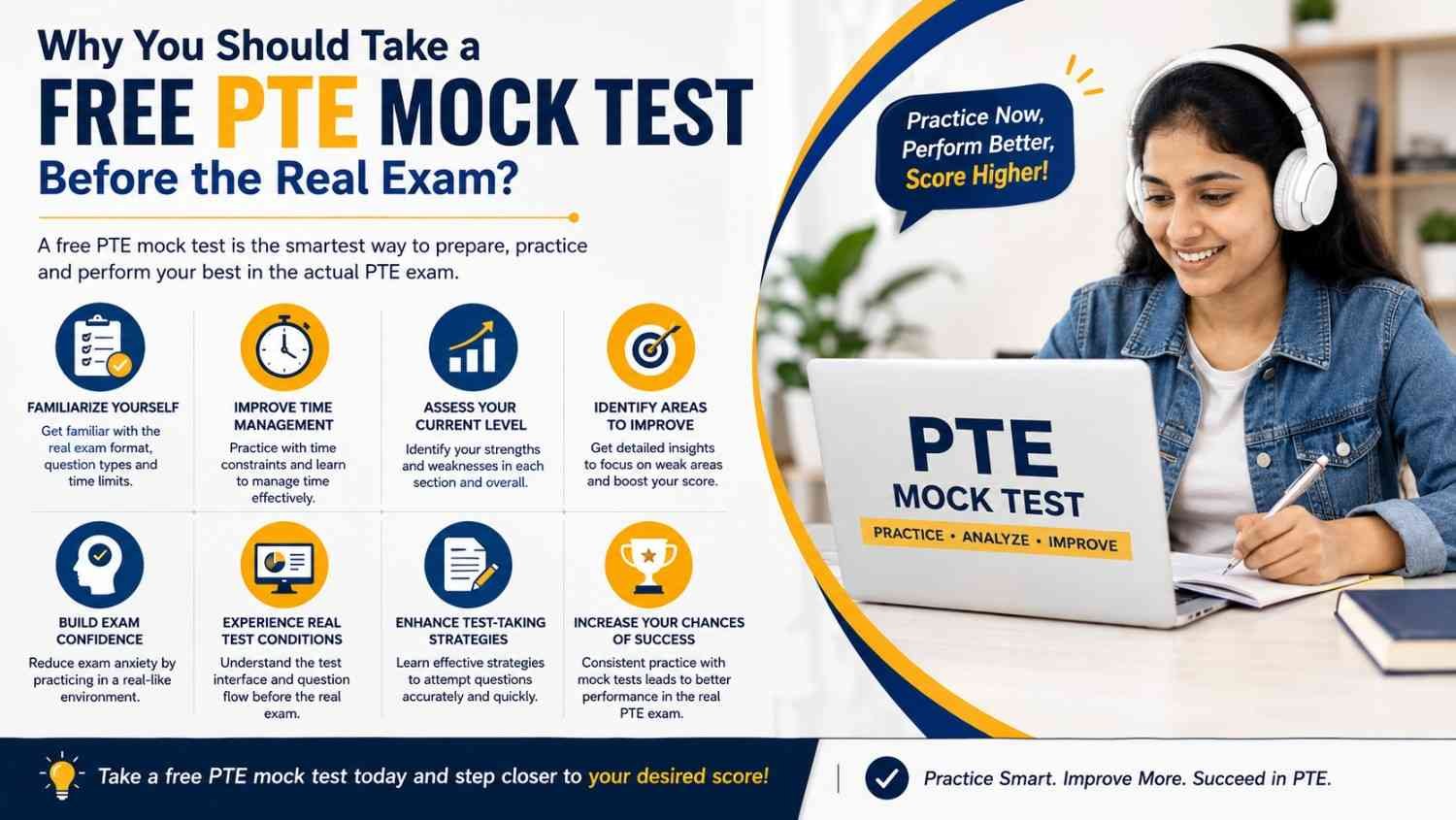
Why You Should Take a Free PTE Mock Test Before the Real Exam?
Preparing for the Pearson Test of English requires more than reading study material and practicing individual questions. Success depends on familiarity with the exam structure, efficient time management, and consistent performance under realistic conditions. A mock test offers an opportunity to measure readiness before booking the official assessment. It highlights strengths, exposes weak areas, and builds confidence through repeated practice. Instead of guessing your level of preparation, you gain measurable feedback that supports smarter study decisions and better performance when the actual exam day arrives.
Why Practice Before the Official Exam Matters?
Every high-stakes language examination measures more than English proficiency. It also evaluates how effectively candidates manage time, respond under pressure, and adapt to different question types. Preparation without regular testing often creates a false sense of confidence.
A realistic mock test closes that gap by replicating the actual testing environment. Consequently, candidates gain practical knowledge about pacing, concentration, and decision-making before facing the official assessment.
Rather than relying on assumptions, practice provides measurable results that reveal where improvement is necessary.
A Mock Test Reflects Your Current Performance Level
Reading grammar books or memorizing vocabulary cannot accurately predict your exam score. Performance only becomes clear after completing tasks within the official time limits.
A quality mock test measures your abilities across every tested skill. Moreover, it helps you evaluate whether your preparation strategy produces consistent results.
After reviewing the results, you can determine whether additional practice should focus on speaking, writing, listening, or reading.
This targeted approach saves valuable preparation time and reduces unnecessary effort.
Build Familiarity With the Exam Format
Many candidates lose marks simply because they are unfamiliar with the exam structure.
Although English skills remain essential, knowing how each section operates prevents avoidable mistakes.
Recognize Different Question Types
Each section contains unique task formats that require specific strategies.
These may include:
- Read aloud
- Repeat sentence
- Describe image
- Retell lecture
- Summarize written text
- Essay writing
- Multiple-choice questions
- Fill in the blanks
- Highlight incorrect words
- Write from dictation
Repeated exposure makes these formats feel natural instead of overwhelming.
Reduce Confusion During the Exam
Candidates who encounter every question type beforehand spend less time figuring out instructions.
Instead, they focus entirely on producing accurate answers.
As a result, mental energy remains available for solving questions rather than interpreting exam requirements.
Improve Time Management Skills
Time pressure remains one of the biggest challenges during any language proficiency examination.
Even candidates with excellent English skills sometimes struggle because they spend too much time on difficult questions.
Practice Working Within Time Limits
A mock examination teaches candidates how long each task should take.
Moreover, regular practice develops a natural rhythm that improves efficiency throughout every section.
Eventually, completing tasks within the allocated time becomes routine rather than stressful.
Identify Slow Sections
Performance reports often reveal where candidates lose valuable minutes.
For example:
- Speaking responses may exceed recommended lengths.
- Reading questions might require excessive review.
- Writing tasks may consume too much planning time.
- Listening activities could involve unnecessary hesitation.
Once these delays become visible, candidates can adjust their preparation accordingly.
Reduce Exam Anxiety Through Familiarity
Fear often comes from uncertainty.
Candidates who never experience a simulated examination environment frequently feel overwhelmed on test day.
Regular mock testing changes that situation.
Instead of entering an unfamiliar setting, candidates recognize the structure, timing, instructions, and workflow.
Consequently, confidence replaces uncertainty.
Although some nervousness remains normal, familiarity significantly reduces unnecessary stress.
Strengthen Mental Readiness
Confidence develops through repeated performance rather than wishful thinking.
Each completed mock examination reinforces positive habits, including:
- Staying calm under pressure
- Following instructions carefully
- Managing time effectively
- Recovering after difficult questions
- Maintaining concentration throughout the exam
These habits contribute directly to better overall performance.
Identify Weak Areas Before They Affect Your Score
Effective preparation depends on honest self-assessment.
Without measurable feedback, many candidates continue practicing skills they already perform well while ignoring weaker sections.
Mock testing provides objective performance data.
Instead of guessing where improvement is necessary, candidates receive clear direction.
Focus Study Time More Efficiently
After reviewing the results, preparation becomes far more strategic.
For example:
- Low speaking scores may require pronunciation practice.
- Weak writing performance may indicate grammar or organization issues.
- Reading challenges could highlight vocabulary limitations.
- Listening errors might reveal concentration problems.
This targeted preparation improves efficiency and maximizes every study session.
Avoid Wasting Valuable Preparation Time
Random study schedules often produce inconsistent progress.
However, performance reports allow candidates to prioritize topics with the greatest impact.
Consequently, every hour of preparation contributes more effectively toward higher scores.
Measure Progress Throughout Your Preparation
Preparation should include measurable milestones rather than assumptions.
A single mock test establishes a starting point.
Additional tests demonstrate whether your preparation strategy continues producing improvement.
Gradual score increases provide motivation while confirming that study methods remain effective.
Conversely, stagnant scores indicate the need for adjustments before the official examination.
Regular evaluation prevents unpleasant surprises on exam day.
Develop Better Question-Solving Strategies
Strong English skills alone do not guarantee excellent results.
Candidates must also know how to approach each task efficiently.
Practice sessions reveal which strategies consistently produce better outcomes.
Improve Decision-Making Under Pressure
Mock examinations encourage faster decisions because every second matters.
Eventually, candidates become more comfortable deciding when to:
- Move to the next question
- Spend additional time reviewing
- Skip unnecessary revisions
- Prioritize higher-value tasks
These decisions improve overall efficiency during the official assessment.
Recognize Common Mistakes Early
Many candidates repeat the same errors without realizing it.
Practice helps identify habits such as:
- Speaking too quickly
- Ignoring punctuation
- Misreading instructions
- Typing carelessly
- Losing concentration during listening sections
Correcting these habits before the official examination prevents unnecessary score reductions.
Experience the Computer-Based Testing Environment
The examination takes place entirely on a computer.
Therefore, familiarity with digital testing becomes an important part of preparation.
Candidates who rarely complete computer-based assessments may initially struggle with navigation, typing speed, or microphone usage.
Repeated practice removes these obstacles.
Moreover, comfortable interaction with the testing interface allows candidates to concentrate on language skills instead of technical details.
During preparation, completing a pte exam free mock test also helps simulate the digital experience expected in the official assessment while providing valuable performance insights.
Improve Typing Speed and Accuracy
Writing tasks require both language proficiency and efficient typing.
Slow typing can reduce the amount of time available for planning, reviewing, and correcting responses.
Fortunately, regular computer-based practice gradually increases typing speed.
Consequently, candidates gain additional time to improve grammar, vocabulary, and sentence structure before submitting their answers.
Furthermore, better keyboard familiarity reduces accidental spelling mistakes caused by rushed typing.
Strengthen Listening Concentration
Listening sections require sustained attention from beginning to end.
Unlike ordinary conversations, recordings continue without interruption.
Therefore, maintaining concentration becomes essential.
Mock tests help candidates train their attention span while adapting to different accents, speaking speeds, and audio quality.
Over time, this consistent practice improves accuracy and reduces missed information during critical listening tasks.
Improve Speaking Confidence
Speaking tasks require clear pronunciation, natural pacing, and confident delivery. However, many candidates hesitate because they worry about making mistakes.
Regular practice builds familiarity with the speaking format. Moreover, repeated attempts help candidates maintain a steady pace without rushing or pausing excessively.
Confidence also improves because candidates know what to expect during every speaking task.
Develop Better Pronunciation
Clear pronunciation improves communication and helps speech remain easy to follow.
Effective preparation encourages candidates to:
- Speak at a natural speed.
- Pronounce words clearly.
- Avoid long pauses.
- Maintain a consistent tone.
- Finish responses within the expected time.
As these habits become routine, speaking performance becomes more consistent.
Enhance Writing Performance
Writing tasks assess grammar, vocabulary, organization, and clarity. Consequently, practicing under realistic conditions plays a significant role in achieving balanced performance.
Mock tests reveal whether candidates spend too much time planning, writing, or editing.
Instead of guessing, they receive measurable feedback that supports better preparation.
Improve Response Structure
Strong writing follows a logical sequence.
Practice encourages candidates to:
- Organize ideas before writing.
- Use clear sentence structures.
- Maintain paragraph flow.
- Check grammar carefully.
- Review spelling before submission.
These habits improve readability while reducing avoidable errors.
Build Reading Accuracy
Reading tasks require both speed and careful attention to detail.
Many candidates read quickly but overlook important information. Others read too slowly and struggle to finish within the allotted time.
Mock testing creates a balanced approach.
Moreover, repeated exposure to reading passages improves scanning, comprehension, and vocabulary recognition.
Strengthen Reading Strategies
Candidates gradually become better at:
- Identifying key ideas.
- Finding supporting details.
- Eliminating incorrect options.
- Recognizing contextual meaning.
- Managing reading time effectively.
These improvements contribute to stronger overall performance.
Gain Better Control During Listening Tasks
Listening sections often challenge candidates because recordings continue without repetition.
Therefore, maintaining focus remains essential from beginning to end.
Regular mock testing strengthens concentration while improving note-taking skills.
Furthermore, candidates become familiar with different speech patterns and accents, making it easier to identify important information.
As concentration improves, confidence naturally follows.
Track Performance With Meaningful Feedback
Preparation becomes more productive when candidates measure improvement over time.
Rather than relying on guesswork, mock test results provide objective feedback that supports smarter planning.
Performance reports often highlight:
- Strongest skills.
- Areas needing improvement.
- Time management patterns.
- Accuracy trends.
- Consistency across sections.
This information allows candidates to modify their study schedule based on actual performance instead of assumptions.
Create a More Effective Study Plan
A structured preparation plan delivers better results than random practice sessions.
Mock test performance helps determine where additional effort produces the greatest improvement.
Set Realistic Weekly Goals
Instead of attempting everything at once, candidates can establish achievable objectives such as:
- Improving speaking fluency.
- Increasing reading speed.
- Expanding vocabulary.
- Strengthening grammar.
- Reducing spelling mistakes.
Moreover, smaller goals create measurable progress while maintaining motivation throughout the preparation period.
Develop Consistency Across All Skills
Success depends on balanced performance rather than excellence in only one section.
Some candidates perform exceptionally well in speaking but struggle with writing. Others achieve strong reading scores while losing marks during listening tasks.
Mock examinations reveal these differences clearly.
Consequently, preparation becomes more balanced, reducing the risk of one weak area affecting the overall score.
Consistent practice supports steady improvement across every tested skill.
Improve Focus During Long Exam Sessions
Maintaining concentration for an extended examination requires mental endurance.
Candidates who practice only short exercises may experience fatigue before completing the official assessment.
Full-length mock tests prepare both the mind and body for longer testing sessions.
Moreover, repeated practice improves attention span, helping candidates remain focused until the final question.
Greater endurance often leads to more consistent performance from beginning to end.
Recognize Progress With Every Attempt
Visible improvement encourages continued effort.
Each completed mock examination provides measurable evidence of development.
For example, candidates may notice:
- Faster completion times.
- Higher accuracy.
- Better speaking fluency.
- Stronger writing organization.
- Improved listening comprehension.
These measurable gains reinforce productive study habits and encourage continued preparation.
Avoid Common Exam-Day Mistakes
Many score reductions occur because of avoidable errors rather than limited English ability.
Practice helps candidates identify these habits before the official examination.
Common mistakes include:
- Ignoring instructions.
- Spending too long on one question.
- Speaking too softly.
- Forgetting to review written responses.
- Losing focus after a difficult question.
- Rushing through easier tasks.
- Mismanaging remaining time.
Recognizing these issues early allows candidates to correct them before they affect final performance.
Use Mock Tests to Build Confidence Gradually
Confidence develops through preparation and consistent practice.
Each completed assessment reinforces familiarity with the testing process.
Moreover, repeated exposure reduces uncertainty while increasing self-belief.
Candidates who regularly evaluate their progress often approach the official examination with greater composure and clearer expectations.
Instead of worrying about unfamiliar situations, they concentrate on demonstrating their language abilities.
Signs You Are Ready for the Official Exam
Preparation reaches a strong level when several indicators appear consistently.
These signs include:
- Stable practice scores across multiple attempts.
- Comfortable time management.
- Confidence in speaking responses.
- Fewer grammar mistakes.
- Better vocabulary usage.
- Strong concentration throughout the test.
- Consistent completion of every section.
- Reduced anxiety before practice sessions.
Although perfection remains unnecessary, consistent performance indicates growing readiness for the official examination.
Best Practices for Mock Test Preparation
Candidates gain the greatest benefit when they treat each practice session as seriously as the real assessment.
Helpful habits include:
- Complete the entire test without interruptions.
- Choose a quiet environment.
- Follow official timing carefully.
- Avoid checking answers during the session.
- Review mistakes immediately afterward.
- Record recurring errors.
- Focus on one improvement area before the next attempt.
- Monitor progress across multiple practice tests.
These practices create realistic preparation while supporting continuous improvement.
Conclusion
A free mock test offers far more than practice questions. It measures readiness, strengthens confidence, improves time management, and highlights areas requiring additional attention. Moreover, consistent practice creates familiarity with the exam format while reducing unnecessary stress. Candidates who evaluate their progress regularly make better preparation decisions and approach the official assessment with greater confidence, stronger skills, and a clear strategy for success.
FAQs
1. Why should I take a free PTE mock test before the official exam?
A free mock test measures your current preparation level, improves familiarity with the exam format, and identifies weak areas before the official assessment. It also strengthens confidence, supports better time management, and helps create a focused study plan based on measurable performance rather than assumptions.
2. How many mock tests should I complete before the exam?
The ideal number depends on your preparation level. Most candidates benefit from completing several full-length mock tests over time. Regular practice allows you to monitor progress, improve consistency, and correct recurring mistakes before taking the official examination.
3. Can a mock test improve my time management?
Yes. Mock tests simulate actual exam timing, allowing you to practice completing every section within the allotted time. As a result, you develop better pacing, avoid spending too long on individual questions, and finish the assessment more confidently.
4. Do mock tests help reduce exam stress?
Yes. Familiarity with the exam format reduces uncertainty and builds confidence. Repeated practice creates a routine, making the official examination feel more predictable and manageable while helping candidates remain calm under pressure.
5. Are mock test scores similar to official exam results?
Although practice scores cannot guarantee official results, they provide a useful indication of your current performance. Consistent scores across multiple mock tests often reflect steady preparation and highlight areas that still require improvement.
6. Which skills should I focus on after a mock test?
Review every section carefully and prioritize weaker areas first. Whether your challenges involve speaking, writing, reading, or listening, targeted practice based on mock test feedback improves efficiency and supports balanced performance across all skills.
7. Should I review every mistake after completing a mock test?
Yes. Careful review helps identify recurring errors, improve strategies, and prevent similar mistakes during the official examination. Analyzing incorrect answers often provides greater value than simply completing additional practice questions.
8. Is it better to take full-length mock tests or section-based practice?
Both approaches provide value. Full-length tests improve stamina and time management, while section-specific practice strengthens individual skills. Combining both methods creates balanced preparation and supports continuous improvement.
9. How can I make my mock test practice more effective?
Complete each practice session under realistic exam conditions, avoid interruptions, follow official timing, and review your performance afterward. Maintaining consistent practice and tracking progress across multiple attempts produces the greatest long-term improvement.
10. When should I stop taking mock tests and schedule the official exam?
Consider scheduling the official examination after achieving consistent scores, completing every section comfortably within the time limit, and correcting recurring weaknesses. Stable performance across multiple practice sessions generally indicates stronger readiness for the real assessment.
