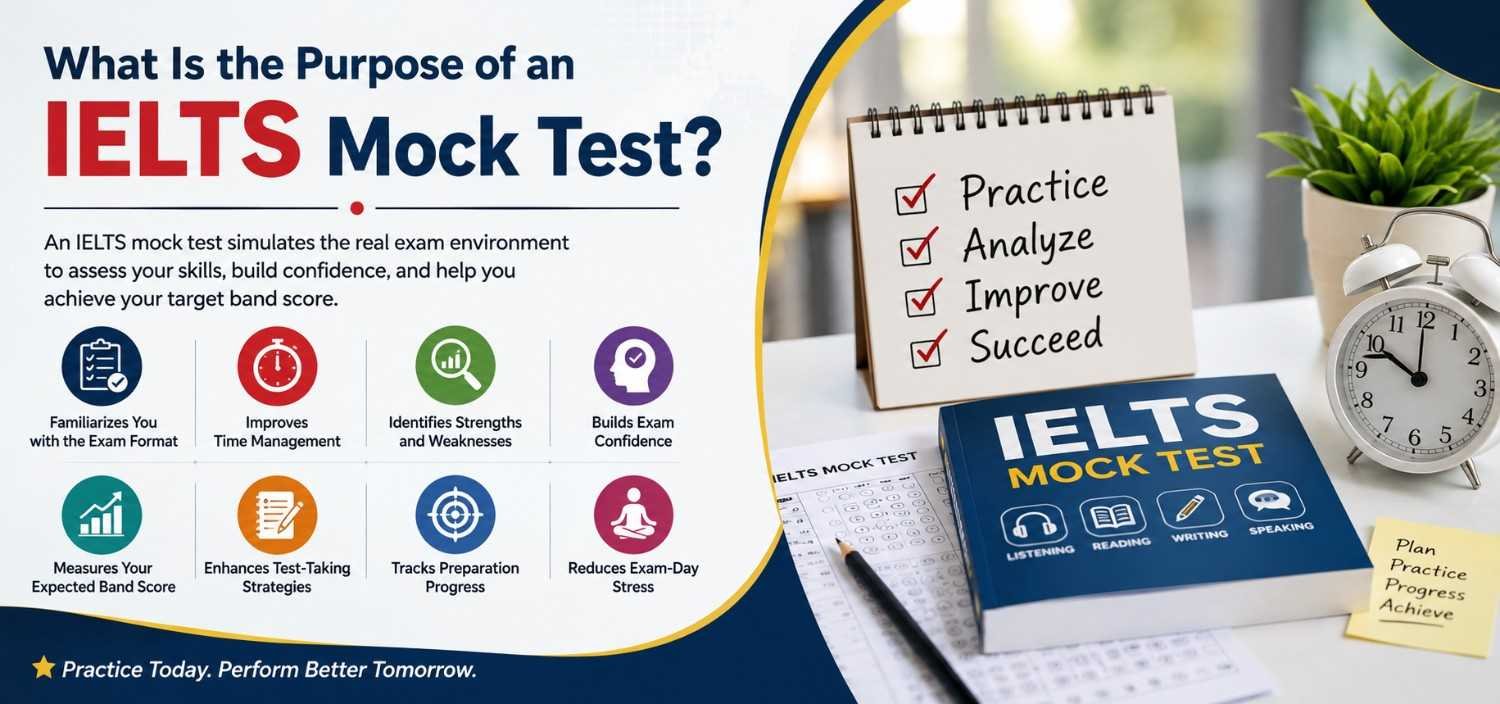
What Is the Purpose of an IELTS Mock Test?
Preparing for the International English Language Testing System requires more than reading study material and practicing grammar. Strong performance depends on familiarity with the exam format, effective time management, and the ability to perform consistently under pressure. A mock test helps candidates measure their readiness before taking the official assessment. It reveals strengths, highlights areas that require improvement, and supports better study planning. Instead of relying on assumptions, candidates receive measurable feedback that helps them prepare with greater confidence and a clearer strategy.
Why Mock Tests Play an Important Role in IELTS Preparation?
Every language proficiency examination measures more than vocabulary and grammar. It also evaluates how effectively candidates manage time, interpret instructions, and respond within strict limits.
A mock test creates a realistic practice environment that closely reflects the official examination. Consequently, candidates become familiar with the testing process before facing the actual assessment.
Rather than depending on guesswork, candidates receive objective results that help them prepare more efficiently.
Measure Your Current Level of Readiness
Preparation should always include regular evaluation.
Reading textbooks and completing isolated practice exercises cannot accurately predict overall performance. However, a full-length mock test measures abilities across every section under realistic conditions.
The results provide valuable insight into your current readiness while identifying the areas that deserve additional attention.
Instead of spending equal time on every topic, candidates can focus on skills that need improvement.
Become Familiar With the IELTS Exam Format
Many candidates lose valuable marks because they feel unfamiliar with the structure of the examination.
Knowing how every section works reduces unnecessary confusion and allows candidates to focus entirely on answering questions accurately.
Recognize Every Question Type
Each section contains different task formats that require specific approaches.
These include:
- Multiple-choice questions
- Matching information
- Sentence completion
- Note completion
- Short-answer questions
- Essay writing
- Letter writing
- Speaking interviews
- Map labeling
- Summary completion
Repeated exposure makes every question type easier to approach.
Follow Instructions More Confidently
Candidates who regularly practice with realistic assessments spend less time interpreting directions.
Consequently, they use more time answering questions instead of figuring out what each task requires.
This simple advantage often contributes to stronger overall performance.
Improve Time Management Throughout the Exam
Many candidates struggle with timing rather than English proficiency.
Even well-prepared individuals sometimes spend too long on difficult questions and rush through the remaining sections.
Mock testing helps eliminate that problem.
Practice Completing Tasks Within Time Limits
Working under official time restrictions develops better pacing.
Moreover, repeated practice helps candidates estimate how much time each question deserves.
Eventually, managing time becomes a natural habit instead of a stressful challenge.
Identify Sections That Require More Time
Performance reports often reveal where valuable minutes disappear.
For example:
- Reading passages may take longer than expected.
- Writing tasks might require excessive planning.
- Speaking responses could become unnecessarily lengthy.
- Listening questions may involve hesitation.
After identifying these patterns, candidates can adjust their preparation more effectively.
Build Confidence Before Exam Day
Confidence grows through preparation rather than assumptions.
Candidates who repeatedly complete realistic mock tests become familiar with every stage of the examination.
As a result, the official assessment feels less intimidating.
Moreover, familiarity reduces unnecessary anxiety and improves concentration during every section.
Instead of worrying about unexpected situations, candidates focus on demonstrating their English skills.
Reduce Performance Anxiety
Stress often affects decision-making and concentration.
Mock examinations help candidates remain calm because they already know the testing process.
Regular practice develops several positive habits:
- Staying focused under pressure
- Managing time efficiently
- Following instructions carefully
- Recovering after difficult questions
- Maintaining steady performance
These habits contribute directly to improved results.
Identify Strengths and Weaknesses
Effective preparation begins with honest evaluation.
Without measurable feedback, candidates often continue practicing skills they already perform well while ignoring weaker areas.
Mock tests provide a clear picture of overall performance.
Consequently, preparation becomes more strategic.
Focus on Skills That Need Improvement
Performance analysis helps candidates prioritize important areas.
For example:
- Speaking may require better fluency.
- Writing might need stronger organization.
- Reading could require faster comprehension.
- Listening may benefit from improved concentration.
Targeted preparation produces better results than random practice.
Avoid Unproductive Study Habits
Many candidates spend hours reviewing familiar topics without improving weaker skills.
Mock test results prevent this mistake.
Instead, every study session focuses on measurable improvement, making preparation more efficient.
Monitor Progress Throughout Your Preparation
Preparation should include regular checkpoints.
A single mock examination establishes a starting point.
Additional assessments demonstrate whether your study methods continue producing improvement.
Higher scores across multiple attempts motivate while confirming that your preparation strategy remains effective.
Conversely, stagnant results indicate the need for adjustments before taking the official examination.
Regular evaluation helps candidates avoid unpleasant surprises.
Develop Better Exam Strategies
Language proficiency alone does not guarantee a strong score.
Candidates must also approach each question efficiently.
Mock testing reveals which strategies produce consistent success.
Improve Decision-Making During the Exam
Practice encourages candidates to make faster and better decisions.
For instance, candidates become more comfortable deciding when to:
- Move to the next question.
- Spend additional time reviewing.
- Skip lengthy reconsideration.
- Prioritize easier questions first.
These decisions improve overall efficiency.
Recognize Repeated Mistakes
Many candidates repeat the same errors without noticing them.
Mock testing highlights habits such as:
- Ignoring keywords.
- Misreading instructions.
- Rushing through passages.
- Spending excessive time editing.
- Losing focus after difficult questions.
Correcting these habits before the official examination increases consistency.
Prepare for Computer-Based Testing
Many candidates choose the computer-delivered version of the examination.
Therefore, becoming comfortable with digital testing offers a significant advantage.
Regular practice improves familiarity with keyboard use, screen navigation, timers, and response submission.
Instead of concentrating on technical details, candidates can devote their attention to language performance.
Completing an IELTS exam mock test also provides valuable practice with computer-based workflows while helping candidates evaluate their readiness before the official assessment.
Improve Writing Speed and Accuracy
Writing tasks require both language proficiency and efficient typing or handwriting, depending on the selected exam format.
Mock tests reveal whether candidates spend too much time planning, writing, or reviewing.
Consequently, preparation becomes more balanced.
Strengthen Written Responses
Consistent practice helps candidates:
- Organize ideas logically.
- Build stronger paragraph structure.
- Improve grammar accuracy.
- Use vocabulary effectively.
- Reduce spelling mistakes.
Over time, writing becomes more organized and efficient.
Strengthen Reading Skills
Reading sections require speed, concentration, and careful analysis.
Many candidates either read too slowly or overlook important details while rushing.
Mock examinations help develop a balanced approach.
Moreover, repeated practice improves scanning techniques, comprehension, and vocabulary recognition.
Build Better Reading Habits
Candidates gradually become more skilled at:
- Identifying key ideas.
- Finding supporting information.
- Eliminating incorrect answers.
- Managing reading time.
- Maintaining concentration throughout long passages.
These improvements support stronger performance across the entire reading section.
Improve Listening Accuracy
Listening requires careful attention from beginning to end because recordings continue without interruption.
Candidates cannot afford to lose concentration even briefly.
Mock tests strengthen listening skills by exposing candidates to realistic audio conditions, different speaking styles, and varied accents.
As concentration improves, candidates become more confident when identifying key information and completing listening tasks accurately.
Develop Stronger Speaking Skills
The speaking section measures fluency, pronunciation, vocabulary, and grammatical accuracy. However, many candidates lose confidence because they have limited practice in realistic interview settings.
Mock tests provide structured speaking practice that closely reflects official conditions. Consequently, candidates become more comfortable answering questions naturally and maintaining a steady pace.
Regular speaking practice also reduces hesitation while improving response quality.
Improve Pronunciation and Fluency
Effective communication depends on clarity rather than speed.
Consistent practice encourages candidates to:
- Speak clearly and naturally.
- Maintain an even pace.
- Reduce unnecessary pauses.
- Organize responses logically.
- Finish answers within the expected time.
These habits improve confidence and create more consistent speaking performance.
Enhance Writing Performance
Writing requires careful planning, clear organization, and accurate grammar.
Many candidates know the language well but struggle to complete tasks efficiently within the time limit.
Mock testing highlights these challenges before the official examination.
Moreover, candidates receive valuable feedback that helps improve sentence structure, paragraph organization, and overall clarity.
Develop Better Writing Habits
Strong writing develops through consistent practice.
Candidates should focus on:
- Planning before writing.
- Presenting ideas logically.
- Using accurate grammar.
- Choosing appropriate vocabulary.
- Reviewing responses before submission.
These habits improve writing quality while reducing avoidable errors.
Increase Accuracy Across Every Section
Strong preparation depends on balanced performance.
Some candidates achieve excellent reading scores but struggle during speaking. Others perform well in listening yet lose marks in writing.
Mock tests reveal these differences clearly.
Consequently, candidates can strengthen weaker areas before taking the official assessment.
Balanced preparation produces greater consistency across the entire examination.
Improve Concentration During Longer Assessments
Completing a full language examination requires sustained attention.
Candidates who practice only short exercises often lose focus during longer sessions.
Full-length mock tests improve mental endurance.
Moreover, repeated practice helps candidates remain attentive from the first question to the last.
Greater concentration reduces careless mistakes and supports more consistent performance throughout the examination.
Measure Progress Objectively
Preparation becomes far more effective when progress is measurable.
Mock tests provide performance reports that reveal improvements over time.
Instead of relying on assumptions, candidates can compare scores and identify meaningful trends.
Performance reports commonly highlight:
- Overall score progression.
- Time management improvements.
- Accuracy across individual sections.
- Frequently repeated mistakes.
- Areas showing consistent growth.
This information supports smarter preparation decisions.
Create a Smarter Study Schedule
Preparation should always follow a structured plan.
Mock test results help candidates decide where additional practice produces the greatest benefit.
Instead of dividing study time equally across every topic, candidates can prioritize weaker skills.
Set Practical Goals
Smaller objectives encourage steady improvement.
Examples include:
- Increasing reading speed.
- Improving speaking fluency.
- Strengthening grammar accuracy.
- Expanding academic vocabulary.
- Reducing spelling errors.
Achievable goals help maintain motivation throughout the preparation period.
Avoid Common Exam-Day Mistakes
Many score reductions result from preventable errors rather than limited English ability.
Fortunately, mock testing exposes these habits before the official examination.
Common mistakes include:
- Misreading instructions.
- Spending too much time on difficult questions.
- Forgetting to review written responses.
- Speaking too quickly.
- Ignoring punctuation.
- Losing concentration after one difficult task.
- Rushing through easier questions.
Recognizing these patterns early allows candidates to correct them before exam day.
Build Confidence Through Consistent Practice
Confidence develops gradually.
Each completed mock examination increases familiarity with the testing process.
Moreover, candidates become more comfortable managing pressure because every practice session reinforces productive habits.
Instead of worrying about unfamiliar situations, they concentrate on demonstrating their English abilities with greater assurance.
This steady improvement creates a positive mindset before the official assessment.
Signs You Are Ready for the Official IELTS Exam
Preparation reaches a strong level when several indicators appear consistently.
Candidates often demonstrate readiness when they can:
- Complete every section within the allotted time.
- Maintain stable practice scores.
- Speak confidently without excessive hesitation.
- Produce organized writing responses.
- Handle reading passages efficiently.
- Maintain concentration during listening tasks.
- Recover quickly after difficult questions.
- Finish full-length mock tests comfortably.
Consistent performance across multiple attempts provides stronger evidence of readiness than one exceptional score.
Best Practices for Using Mock Tests Effectively
Candidates receive greater value when they treat every practice session like the official examination.
Helpful practices include:
- Complete the full test without interruptions.
- Choose a quiet environment.
- Follow official timing carefully.
- Avoid checking answers during the test.
- Review mistakes immediately afterward.
- Record recurring weaknesses.
- Focus on improving one major area before the next attempt.
- Monitor progress across several mock tests.
These habits create realistic preparation while supporting continuous improvement.
The Long-Term Value of Regular Mock Testing
Mock tests provide benefits that extend beyond score prediction.
Candidates improve discipline, planning, concentration, and decision-making through repeated practice.
Furthermore, they develop realistic expectations about exam difficulty and pacing.
Consistent evaluation also reduces uncertainty because preparation follows measurable progress instead of guesswork.
As a result, candidates approach the official examination with greater confidence, improved organization, and stronger overall performance.
Conclusion
An IELTS mock test serves as an essential preparation tool that measures readiness, improves time management, strengthens confidence, and highlights areas requiring additional attention. Moreover, regular practice creates familiarity with the exam structure while encouraging smarter study decisions. Candidates who evaluate their performance consistently enter the official examination with clearer expectations, stronger skills, and greater confidence in their ability to achieve their target score.
FAQs
1. What is the main purpose of an IELTS mock test?
An IELTS mock test measures your current preparation level under realistic exam conditions. It helps identify strengths and weaknesses, improves familiarity with the exam format, and supports better study planning. Regular practice also builds confidence before the official assessment.
2. How many IELTS mock tests should I take before the exam?
Most candidates benefit from completing several full-length mock tests during their preparation. Multiple attempts allow you to monitor progress, improve consistency, strengthen weaker skills, and become more comfortable with the official exam structure and timing.
3. Can a mock test improve my time management?
Yes. Mock tests simulate official timing and help you practice completing every section within the allotted time. Consequently, you develop better pacing, avoid unnecessary delays, and improve your ability to finish the examination confidently.
4. Do IELTS mock tests reduce exam anxiety?
Yes. Familiarity with the exam process reduces uncertainty and increases confidence. Regular practice helps candidates remain calm under pressure because they already know the structure, timing, and expectations of the official examination.
5. Are mock test scores similar to official IELTS results?
Mock test scores provide a useful indication of your current preparation level. Although they cannot guarantee official results, consistent performance across several practice tests often reflects steady progress and stronger readiness for the examination.
6. Which section should I focus on after taking a mock test?
Focus on the section where your performance remains weakest. Whether you need improvement in speaking, writing, reading, or listening, targeted practice based on mock test feedback produces more effective and balanced preparation.
7. Should I review every mistake after completing a mock test?
Yes. Reviewing mistakes helps identify recurring errors, improve strategies, and prevent similar problems during the official examination. Careful analysis often contributes more to improvement than simply completing additional practice questions.
8. Is a full-length mock test better than section-based practice?
Both methods provide value. Full-length tests improve endurance and time management, while section-specific practice strengthens individual skills. Combining both approaches creates balanced preparation and supports continuous improvement.
9. How can I make my mock test practice more effective?
Practice under realistic exam conditions by following official timing, avoiding interruptions, completing every section, and reviewing your performance afterward. Consistent evaluation and focused improvement help maximize the benefits of every mock test.
10. When should I schedule the official IELTS exam?
Consider scheduling the official examination after achieving consistent mock test scores, completing every section comfortably within the time limit, and reducing recurring mistakes. Stable performance across multiple practice sessions usually indicates stronger readiness for the real exam.
